
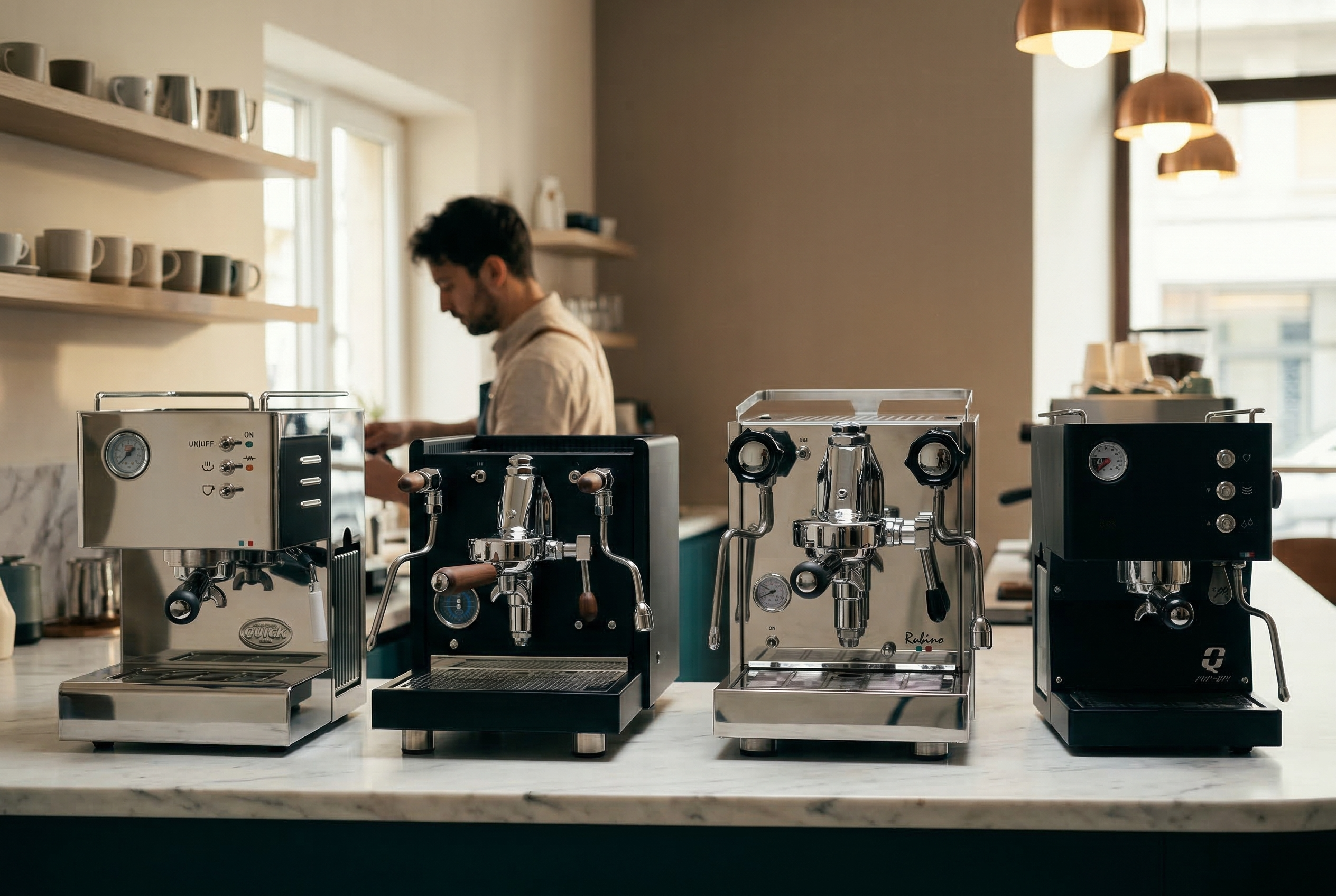
Choosing an espresso machine for your home can feel overwhelming, especially with so many models, features, and technologies available today. Whether you’re buying your first espresso maker or upgrading to a more advanced system, understanding what makes a good espresso machine will help you make a confident and informed decision.
At Quick Mill, we have been designing and manufacturing espresso machines in Italy since 1945, focusing on reliability, craftsmanship, and the quality of the coffee experience. Drawing on this long-standing expertise, this guide explains the key factors to consider before buying an espresso machine, helping you choose the model that best fits your needs.
When you start exploring how to choose an espresso machine, the first real decision is which type of machine suits your skill level and expectations. Each category offers a different balance between control, automation, and learning curve.
Manual (lever) espresso machines are the most hands-on option. You generate the pressure using a lever and influence every part of the extraction.
Key characteristics:
Best suited for:
If you are just starting out and want quick, repeatable results, a manual machine might feel demanding at first.
Semi-automatic machines are often the “sweet spot” for home barista use. The pump is electric, so you don’t have to generate pressure yourself, but you still control dose, grind, tamp, and when to start or stop the shot.
Key characteristics:
Best suited for:
For many people wondering how to pick an espresso machine, a semi-automatic model is the ideal long-term choice.
Automatic (and super-automatic) machines are designed for convenience. They can handle some or all of the processes for you: grinding, dosing, tamping, extraction, and sometimes even milk frothing.
Key characteristics:
Best suited for:
If your main priority is simplicity and consistency rather than mastering every variable, an automatic espresso machine is often the most comfortable option for everyday use.
Once you know the type of machine that suits your needs, the next step is evaluating the technical features that determine durability, usability, and cup quality.
Temperature stability is one of the most important factors in determining the quality of an espresso. Even small fluctuations—just a few degrees—can influence crema, mouthfeel, sweetness, acidity, and extraction uniformity.
When evaluating what to look for when buying an espresso machine, consider these features and specifications that directly influence thermal consistency:
Temperature stability is one of the key elements that influence espresso quality. Even small variations during extraction can affect crema, sweetness, body and acidity. For this reason, many home machines use systems designed to keep brew water as stable as possible — and one of the most well-known among them is the PID controller.
A PID system (Proportional-Integral-Derivative) electronically regulates the heating element to minimise temperature swings. However, it’s important to understand that while a PID is a strong indicator of precision and consistency, it is not the only way a machine can achieve stable brewing conditions. Many automatic and super-automatic machines rely instead on carefully calibrated thermoblocks, insulated circuits or proprietary thermal algorithms that deliver very stable results without requiring user adjustments — which is why the absence of a PID in these categories is perfectly normal.
Models such as the Quick Mill Pop, Aquila and Rubino are equipped with precise PID controllers. These machines maintain a stable brewing temperature within a tight range and allow small adjustments based on coffee type, an essential feature for achieving balanced and repeatable extractions.
How do you adjust a PID and is it easy?
On machines where the user can adjust PID settings (such as several Quick Mill semi-automatic models), temperature changes are made via a small digital interface. The process itself is simple – usually a matter of pressing a button or two – but understanding how much to adjust requires a bit of experience, because different coffees behave differently at different temperatures:
In short, the interface is easy, but the choice requires practice.
On super-automatic machines, users typically cannot and do not need to adjust temperature manually: the machine manages everything internally, ensuring consistency for those who prefer a simplified experience.
Some Quick Mill models also use Instant Stability technology, an advanced thermal solution designed to keep the brew circuit extremely stable even during consecutive shots or when alternating between brewing and steaming. This system ensures rapid thermal recovery, minimal temperature deviation, and allows the machine to be ready in just 12 minutes!
The boiler system defines how the machine manages heat, how quickly it’s ready to brew, and how easily it can produce espresso and steam in sequence.
A single boiler machine uses one boiler for both brewing and steaming.
Key features:
A heat exchanger (HX) machine uses a single steam-temperature boiler with an internal heat-exchange tube that heats fresh brew water on demand.
Key features:
A double boiler machine has two independent boilers: one for brewing and one for steaming.
Key features:
Thermoblock
A thermoblock system uses a compact heating element that heats water on demand as it flows through the machine. This technology allows very fast heat-up times and improved energy efficiency compared with traditional boilers.
Quick Mill pioneered thermoblock technology in espresso machines and continues to refine it in many of its home models.
Key features:
Machine size and construction materials play a key role in performance, durability, and ease of use. Before buying, it’s important to evaluate a combination of structural quality, internal components, and practical design features:
Stainless-steel body and internal components improve durability and heat retention
Solid frame and quality fittings reduce vibration and ensure stability during use
Appropriate footprint and height allow the machine to fit comfortably on your counter
High-quality brew components (brass, copper, or stainless steel) support consistent extraction and longevity
Well-insulated boilers or thermoblocks enhance thermal stability and energy efficiency
Accessible water tank and drip tray make daily use and maintenance easier
Quick Mill machines are known for their robust stainless-steel construction, commercial-style group heads, and long-lasting internal components, designed to deliver stable temperatures, reliable performance, and durability over many years of daily use.
The pump is the component that generates the pressure needed to extract espresso, and the way it operates can influence both performance and the overall experience of using the machine. Most home espresso machines rely on vibratory pumps, which work using an electromagnetic piston. These pumps are compact, reliable, and commonly found in domestic machines. They provide excellent extraction pressure but tend to produce a bit more noise and a slightly more pulsated flow compared to other systems.
Quick Mill machines are designed to reduce operating noise compared to many standard machines on the market. Our vibratory pumps can reduce noise by up to 30%, making everyday coffee preparation noticeably quieter while maintaining consistent extraction performance.
Higher-end home machines may instead feature a rotary pump, a mechanism similar to those used in commercial espresso machines. Rotary pumps run more quietly, deliver smoother and more stable pressure, and generally provide a more refined brewing experience.
In Quick Mill machines equipped with this system, rotary pumps can be up to 40% quieter than typical market alternatives, ensuring a smoother and more comfortable workflow while maintaining highly stable pressure during extraction.
While both pump types can produce high-quality espresso, rotary pumps offer a more polished and professional feel, whereas vibratory pumps remain a dependable and efficient solution for most home users.
The portafilter is where the coffee puck is held during extraction. Size influences how the coffee bed wets and how evenly water flows through the ground coffee.
For home espresso machines, a 58 mm portafilter is considered desirable because:
Ease of use is an essential factor when choosing an espresso machine, but it varies significantly depending on the machine type. A good machine should feel intuitive — with clear controls, logical functions and easy access to the water tank and drip tray — yet the overall difficulty of using it depends on how much manual interaction it requires.
For example, semi-automatic machines offer the highest level of control, but they also demand more involvement: you adjust the grind, tamp the coffee, start and stop the shot, and learn to balance the variables. This makes them ideal for users who enjoy the hands-on barista workflow and are willing to learn, experiment and refine their skills over time.
Manual and lever machines require even more technique and are best suited to enthusiasts who want full control and appreciate a learning curve.
On the other side of the spectrum, super-automatic machines are designed for maximum convenience and consistency. A model like the Quick Mill 05000 handles grinding, dosing, brewing and steaming automatically, thanks to its integrated 49 mm flat-burr grinder and thermoblock heating system. This makes it an excellent choice for users who want quality espresso and milk drinks with minimal manual input or for those who prefer a simple, guided experience rather than managing every brewing variable.
Ultimately, ease of use depends on your experience, your comfort with manual steps, and how much you want to learn or automate. Matching the machine’s complexity to your personal preferences ensures that using it feels enjoyable — whether you’re seeking full barista control or a quick, effortless coffee every morning.
Beginners may prefer simple and compact machines such as the Quick Mill 0820 and Orione. Intermediate users often choose semi-automatic models like the Pop-up, Pop and Rubino+, while advanced home baristas benefit most from dual-boiler machines like the Elevate R or Elevate V.
Neither. Espresso is extracted at around 9 bar. What really matters is pressure stability, not the maximum pressure advertised.
A typical espresso shot runs in about 25–30 seconds. Faster extractions may taste sour; slower ones can be bitter.
Look for consistent brewing performance, adjustable drink settings, ease of cleaning and an integrated grinder. Machines like the Quick Mill 05000 provide an intuitive one-touch workflow.
Stable temperature, consistent pressure, high-quality materials, the right boiler system and a level of automation that matches your experience and preferences.